Gentile Wash, Utah
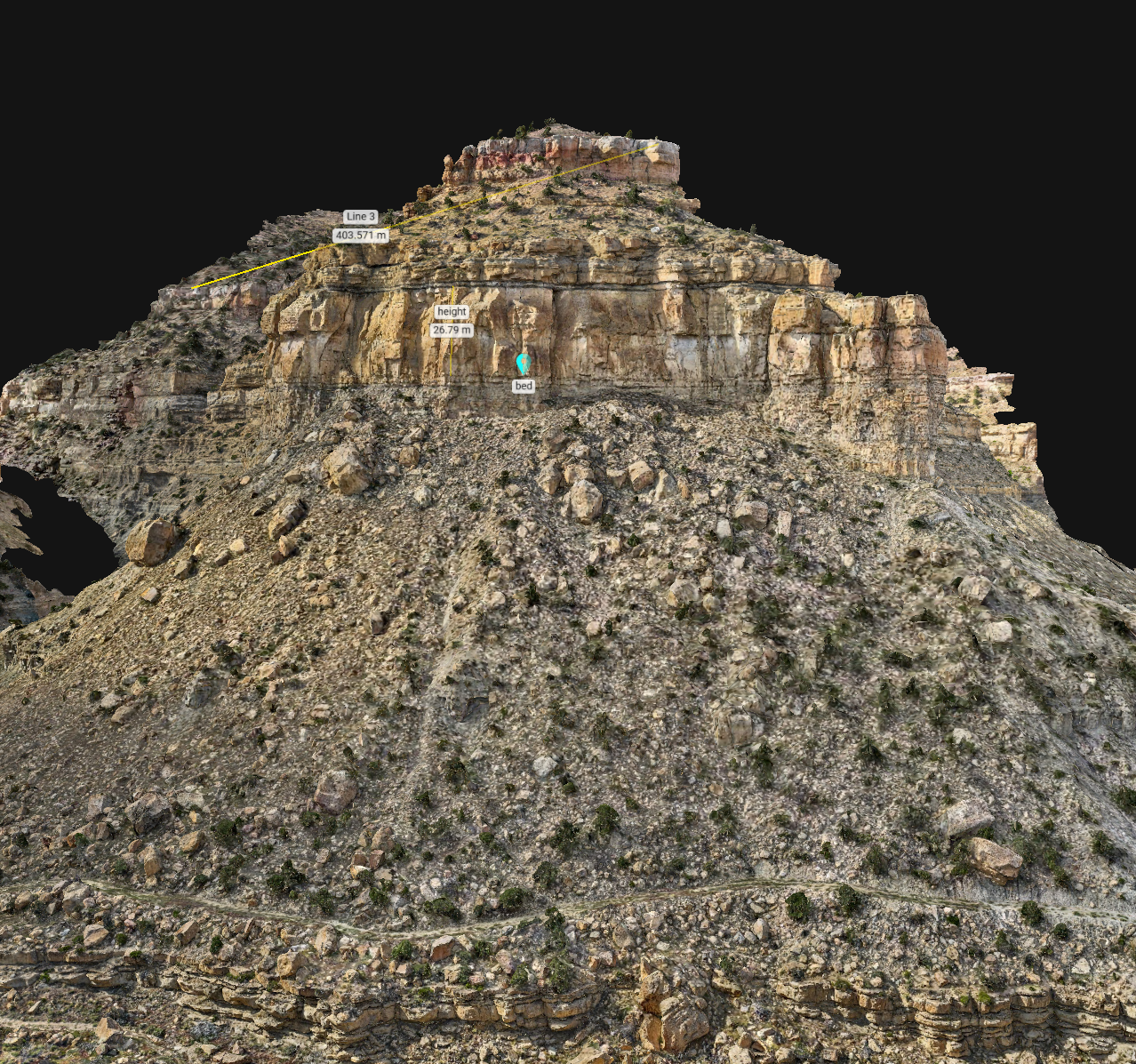
Gentile Wash, located near Helper/Price in the Book Cliffs of east-central Utah, exposes a classic Upper Cretaceous (Campanian) clastic succession within the Star Point Sandstone and lower Blackhawk Formation. This site serves as a premier outcrop analog for deltaic and shoreface sedimentation along the western margin of the Western Interior Seaway, offering exceptional three-dimensional exposure of sequence stratigraphic architecture and sedimentary processes in a foreland basin setting.
From a sedimentological perspective, the succession records the interplay of fluvial sediment supply, wave and storm reworking, relative sea-level fluctuations, and subsidence during eastward progradation of the seaway shoreline. The basal contact with the underlying Mancos Shale marks a sequence boundary expressed as a correlative conformity in this distal position. It transitions into the Panther Tongue Member (Star Point Sandstone), interpreted as a river-dominated delta deposited during forced regression (falling-stage to lowstand systems tract).
Panther Tongue Sedimentology
The Panther Tongue exhibits a distinctive coarsening- and thickening-upward profile with clinothems that dip gently basinward. Key facies associations include:
Lower delta-front deposits: Thinly interbedded sandstones and bioturbated mudstones featuring Bouma-type turbidite sequences (e.g., Ta-e divisions with flute casts, climbing ripples, and parallel laminations), reflecting hyperpycnal flows and storm-induced density currents from river effluent.
Upper delta-front to mouth-bar deposits: Amalgamated lensoid sandstones with structureless, parallel-laminated, and trough cross-laminated fabrics, indicating rapid deposition from sediment-laden jets, followed by minor reworking. These form lobate, clinothem-scale bodies with evidence of channel-mouth bar accretion.
Paleocurrent indicators and facies geometry support fluvial dominance with limited wave influence in proximal parts, contrasting with more wave-reworked equivalents elsewhere. The top of the Panther Tongue is a sharp, erosional transgressive surface characterized by intense bioturbation (e.g., Rosselia, Ophiomorpha), oscillatory ripples, mud clasts, wood molds, and shell fragments—hallmarks of wave ravinement and substrate colonization during initial marine flooding.
Overlying Units
Overlying the transgressive surface are the retrogradationally stacked parasequences of the Storrs Member (Star Point), representing the transgressive systems tract. These consist of distal to proximal shoreface successions: interbedded mudstones and ripple-laminated sandstones (transition zone) grading upward into hummocky cross-stratified (HCS) and amalgamated sandstones of the lower shoreface. The retrogradational pattern reflects diminishing progradational extent with successive parasequences, culminating near a maximum flooding surface (condensed interval with finer-grained, more bioturbated deposits).
Higher in the section, the Spring Canyon Member (Blackhawk Formation) records the early highstand systems tract with progradationally stacked, more proximal wave-influenced shoreface parasequences. These feature well-developed upward-coarsening profiles from HCS and combined-flow strata (lower shoreface) to trough cross-bedded and parallel-laminated upper shoreface/foreshore sandstones, commonly capped by coaly coastal-plain deposits. This reflects increasing sediment supply relative to accommodation during highstand, with greater preservation of proximal facies.
Broader Context
Petrographically, these sandstones are quartzose to subarkosic, with variable detrital input from Sevier orogenic sources. Ichnological assemblages (e.g., Cruziana to Skolithos ichnofacies transitions) and trace-fossil diversity further delineate energy gradients, salinity stress, and oxygenation levels across the deltaic to shoreface spectrum. Quantitative studies of clinothem geometry and architectural elements at Gentile Wash have informed reservoir modeling, highlighting along-strike variability in sand-body connectivity and heterogeneity between river- and wave-dominated end-members.
In summary, Gentile Wash encapsulates the sedimentological response to high-frequency eustatic and tectonic controls in a rapidly subsiding foredeep, providing a natural laboratory for linking process sedimentology (hyperpycnal flows, storm reworking, ravinement) to larger-scale sequence architecture. Its accessibility and completeness continue to underpin global training in clastic sequence stratigraphy.
Sources and References
Field Localities in the Book Cliffs to Understand Sequence Stratigraphic Concepts (detailed guide including Gentile Wash hike and facies descriptions): https://www.researchgate.net/publication/378134348_Field_localities_in_the_Book_Cliffs_to_understand_sequence_stratigraphic_concepts
Clastic sedimentology, sedimentary architecture, and sequence stratigraphy of the Book Cliffs (GSA publication): https://pubs.geoscienceworld.org/gsa/books/edited-volume/2665/chapter/144894259/Clastic-sedimentology-sedimentary-architecture-and
The Geometry and Internal Architecture of Stream Mouth Bars in the Panther Tongue: https://pubs.geoscienceworld.org/sepm/jsedres/article/80/11/1018/145296/The-Geometry-and-Internal-Architecture-of-Stream
Quantifying clinothem geometry in a forced-regressive river-dominated delta, Panther Tongue Member: Key paper on sedimentology (via Wiley/Sedimentology). https://onlinelibrary.wiley.com/doi/10.1111/j.1365-3091.2010.01164.x
USGS Professional Paper 332: Cretaceous and Tertiary Formations of the Book Cliffs: Foundational stratigraphy. https://pubs.usgs.gov/pp/0332/report.pdf
Additional resources often reference works by Balsley & Horne, Enge et al., Howell et al., and field guides from SEPM or Utah Geological Association for deeper ichnological and architectural analysis.